Four Cold Room Faults to Check When Cooling Fails
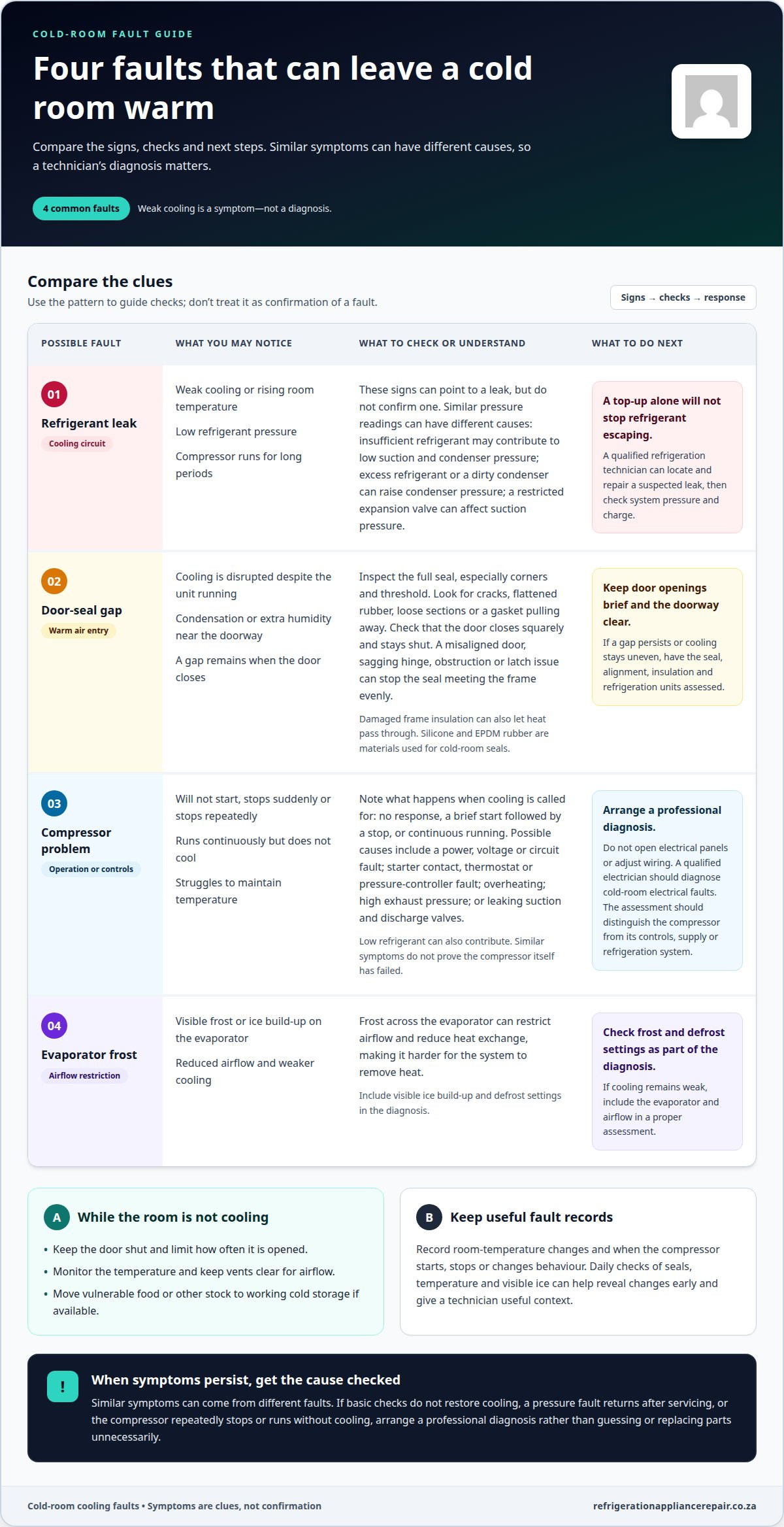
A refrigerant top-up alone won’t fix a leak. Weak cooling, low refrigerant pressure and a compressor running for long periods can point to escaping refrigerant, which must be located and repaired. That’s the starting point for cold room not cooling repair.
When a cold room stops holding temperature, the refrigeration unit may seem the obvious suspect. But the cause could also be a door-seal gap, a compressor fault or frost restricting airflow. Recognising the signs helps you understand what may be wrong and when a technician’s diagnosis is needed.
This guide explains four common faults and how each can affect cooling: refrigerant leaks, warm air entering through damaged seals, compressor problems and evaporator frost. Use the symptoms to understand what may be happening and what to do next.
Key Takeaways
- Weak cooling and a compressor running for long periods can point to a refrigerant leak. A top-up alone won’t stop refrigerant escaping.
- A door that doesn’t seal tightly can let warm air in. Look for gaps that may be undermining cooling.
- A compressor that won’t start, stops suddenly or runs continuously can signal a fault that needs a proper diagnosis.
- Frost on the evaporator can restrict airflow and reduce cooling. Defrost settings and ice build-up are worth checking as part of the diagnosis.
1. How do I know if my cold room has a refrigerant leak?
Weak cooling, low refrigerant pressure and a compressor running for long periods can indicate a refrigerant leak. The temperature may rise even while the unit keeps running, putting stored stock at risk. These signs suggest a problem, but don’t confirm a leak on their own.
Pressure readings can help narrow down the cause. Insufficient refrigerant can contribute to low suction and condenser pressure, while excess refrigerant or a dirty condenser can raise condenser pressure. A blocked or restricted expansion valve can also affect suction pressure. Since several faults can produce similar readings, a technician needs to assess the system rather than simply add refrigerant.
A top-up alone won’t stop refrigerant escaping through a leak. A qualified refrigeration technician uses specialised equipment to locate suspected leaks, repair them and check the system’s pressure and charge. Arrange an on-site assessment if cooling remains weak, the compressor runs for long periods or a pressure fault returns after servicing. If basic checks don’t restore cooling, seek a professional diagnosis promptly.
To find a qualified cold room repair technician near you in South Africa, look for someone who works on commercial refrigeration and can test for leaks with specialised equipment. Share the symptoms, such as weak cooling or a compressor that keeps running, so the fault can be assessed.
While the room is not cooling, keep its door shut and limit how often it’s opened. Monitor the temperature, keep vents clear for airflow, and move vulnerable food or other stock to working cold storage if available.
Include refrigeration units, refrigerant leaks, temperature controls and electrical systems in routine checks. Keeping records can show whether the temperature stays consistent or begins drifting, giving a technician useful information about when the fault started.
2. Cold room door seals and warm air leaks
A damaged, worn or loose cold-room door seal lets warm air enter. That extra heat makes the refrigeration unit work harder and can disrupt the temperature around stored stock. Moist air may also increase humidity and encourage condensation near the doorway. A gap can therefore contribute to cooling problems even when the unit is running.
Inspect the full door seal, especially the corners and threshold, where dirt or damage can prevent proper contact. Look for cracks, flattened rubber, loose sections or a seal pulling away from its fixing. Check whether the door closes squarely and stays shut without being pushed. A seal can look intact but still fail if the door is misaligned.
Insulation and door seals work together to limit heat entering the room. Damaged insulation around the frame can leave cold spots or let outside heat pass through, even after a gasket is replaced. The seal must meet the frame evenly; otherwise, a new gasket may still leave a gap. Silicone and EPDM rubber are materials used for cold-room seals.
Door closure matters too. A sagging hinge, obstruction or latch problem can stop the gasket compressing against the frame. For example, if the upper edge touches but the lower corner remains open, warm air can enter through the gap. Leaving the door open for long periods also brings in warm, moist air. Keep openings brief and make sure the doorway is clear.
Daily checks of door seals, room temperature and visible ice build-up can help reveal a change early. If a gap remains after the door closes, or cooling stays uneven, the seal, alignment, insulation and refrigeration units need a proper assessment. For a persistent fault, cold-room repair support can help identify whether the door assembly or another cooling component needs attention.
3. Compressor failures and maintenance
A compressor fault can leave a cold room warm even when its controls appear active. Watch for a unit that won’t start, stops suddenly, runs continuously or struggles to maintain temperature. Other faults can cause similar symptoms, so avoid guesswork and arrange a diagnosis.
If the compressor won’t start, possible causes include a power supply, voltage or circuit fault. A faulty starter contact, thermostat or pressure controller can also prevent it from operating. Note what happens when the unit is called to cool: no response, a brief start followed by a stop, or continuous running. This detail helps narrow down the fault.
A compressor that starts and then stops may be affected by low voltage, high exhaust pressure or motor overheating. A compressor running without stopping can point to a faulty control system or leaking suction and discharge valves. Low refrigerant levels can also contribute to compressor failure. Overheating, low efficiency and electrical problems may damage the compressor or prevent it from cooling properly.
Don’t open electrical panels or adjust wiring yourself. Cold-room electrical faults should be diagnosed by a qualified electrician. A full assessment can distinguish a supply or control issue from a compressor fault, helping avoid unnecessary replacement. If the compressor repeatedly trips, stops during operation or runs continuously without cooling, arrange a professional diagnosis.
Maintenance should include checking the compressor’s operation alongside the controls and electrical components. Record when the compressor starts, stops or changes behaviour, and note any temperature changes in the room. For example, a temperature rise at the same time as repeated compressor stops gives the technician a useful fault pattern.
Low compressor efficiency may call for repair or replacement, depending on the fault and the unit’s condition. Diagnosis should establish whether the cause lies in the compressor, its controls, the electrical supply or the refrigeration system. The distinction matters: replacing a compressor won’t resolve an underlying electrical fault, which could disrupt cooling again.
4. Frost on the evaporator and defrost settings
A layer of frost across the evaporator can restrict airflow and reduce heat exchange. The refrigeration system then struggles to remove heat, so room temperature may rise while the unit continues running. Ice on a unit cooler or exhaust pipe can also point to a defrost issue that needs attention.
Defrosting can be manual or controlled by an automatic system. Settings must suit the cold room and operate correctly; a faulty cycle can allow ice to build up again. Check whether defrost occurs as configured and whether the evaporator clears afterwards. Persistent frost calls for diagnosis, not repeated defrosting alone.
Airflow matters too. Keep stored goods clear of evaporator fans and vents, as blocked airflow can contribute to uneven cooling. Clean evaporator coils and fans regularly to support airflow and efficiency. If frost returns quickly after cleaning or defrosting, a technician can assess the controls, coil condition and refrigeration system together.
The expansion valve can also affect evaporator performance. If it is incorrectly adjusted or blocked by ice, refrigerant flow may be disrupted and cooling can suffer. Moisture can contribute to a blocked valve; replacing the filter drier can help prevent future freezing. Dirt in the valve or filter is another possible fault that requires proper cleaning and inspection.
Don’t overlook the condenser during troubleshooting. A dirty condenser can contribute to high condenser pressure, so cleaning it may address that particular cause. Insulation and door sealing also matter: warm, moist air entering the room can encourage further ice build-up. Correct defrost settings and a well-sealed room help limit recurring frost. Ice left on coils can reduce efficiency and may damage stored products or the room structure. If frost keeps returning or cooling remains poor, arrange cold-room repair for a full system assessment.
Access Refrigeration & Appliance Repairs: Cold-room repairs
Access Refrigeration & Appliance Repairs provides on-site cold-room repairs when rising temperatures, recurring frost or persistent cooling faults put stored stock at risk. A technician can assess the refrigeration system and identify whether the problem involves a leak, door seal, compressor, electrical component or defrost cycle. Identifying the cause helps direct the repair rather than treating only the symptom.
Arrange an on-site repair if the cold room continues to lose temperature, the compressor behaves unusually or frost returns after defrosting. Share the symptoms and any temperature changes so the fault can be investigated with useful context. Access Refrigeration & Appliance Repairs also handles on-site fridge and freezer repairs.
Contact Access Refrigeration & Appliance Repairs to discuss an on-site cold-room repair.
Take the next step to protect your stock
Cooling failures can disrupt stock management and daily operations. Once a fault appears, record temperature changes, affected goods and any unusual equipment behaviour. This gives the repair assessment useful context and helps you decide which stock needs attention first. Keep the cold-room door closed as much as possible while the issue is addressed.
Cold room not cooling repair should focus on identifying the fault before treating its symptoms. If cooling keeps failing or the temperature continues to rise, arrange an on-site professional assessment rather than relying on repeated resets or refrigerant top-ups. Explain what has changed and how the room is behaving.
Access Refrigeration & Appliance Repairs also handles fridge repairs, freezer repairs and dishwasher repairs. Contact Access Refrigeration & Appliance Repairs about your cold room and take the next step towards restoring dependable cooling.
Frequently Asked Questions
How do I know if my cold room has a refrigerant leak?
A refrigerant leak can’t be confirmed from the room’s temperature display alone. Tell the technician when the cooling change began and whether the system has had previous refrigerant work. That history can help distinguish a recurring leak from a new fault. Keep any service records available, including notes on when the room’s temperature first started changing.
Why is my compressor running but not cooling?
A running compressor doesn’t prove the whole refrigeration system is working effectively. The fault may lie elsewhere in the cooling circuit or its controls. Note whether the unit’s behaviour changes after a power interruption, and avoid repeatedly switching it off and on to test it. A technician can assess the system as a whole before deciding which component needs attention.
What are the common reasons a cold room is not cooling?
Cooling problems can come from the refrigeration circuit, room sealing, airflow, controls or electrical components. Similar symptoms can have different causes, so a warm room alone doesn’t identify which part has failed. Consider whether the problem appeared after a change in operating conditions or maintenance. That timeline can help focus the diagnosis without assuming a particular component needs replacing.
How do I troubleshoot a cold room that is not reaching the set temperature?
For a cold room that is not cooling, repair starts with useful observations, not repeated setting changes. Record the set temperature and displayed reading, along with the time and any recent changes to the room’s use. Avoid lowering the set point repeatedly, as this won’t correct an underlying fault. Share those observations during an on-site professional assessment if the temperature gap persists.
How can I check a cold room thermostat, evaporator fan, and condenser?
Use the controls and visible condition as basic clues, without removing covers or reaching near moving parts. Note whether the thermostat display responds when its setting changes, whether the fan appears to operate, and whether the condenser surface looks obstructed. These observations don’t establish the fault, but give a technician specific details to investigate during an on-site diagnosis.
When does a cold room need refrigerant leak detection or a refrigerant recharge?
Arrange on-site leak detection when a technician suspects refrigerant is escaping, particularly if cooling problems return after previous refrigerant work. A cold room that is not cooling may need repair before its refrigerant charge is addressed. The technician’s findings determine whether a leak needs repair and whether the charge requires attention. Avoid treating a recurring fault as a routine top-up.